Photo: Daniel J. Cox
Frequently Asked Questions
Here, you’ll find the answers to frequently asked questions about polar bears, sea ice, climate warming, and more.
Polar bears are listed under a variety of classifications depending on international, national, and regional regulations. Internationally, they are listed as a vulnerable species by the IUCN. In Russia, polar bears are classified as a Red Data Book species, a listing that includes animals considered rare or endangered. In the U.S., polar bears are listed as a threatened species under the Endangered Species Act. Canada considers polar bears a species of special concern under the National Species at Risk Act. On a regional level in Canada, polar bears are listed as threatened in both Manitoba and Ontario under provincial endangered species legislation.
In all cases, the primary conservation concern for polar bears is habitat loss and reduced access to their seal prey due to climate change. Scientists predict that as the Arctic continues to warm, two-thirds of the world's polar bears could disappear within this century. Research also shows that hope remains if action is taken to greatly reduce carbon emissions soon.
While rapid loss of sea ice is the primary threat to the polar bear’s long-term survival, other challenges include pollution, increased commercial and industrial activity in the Arctic, overharvest, disease, and inadequate habitat protection (denning and seasonal resting areas).
At the 2014 meeting of the PBSG, the world's leading polar bear scientists reported that of the 19 subpopulations of polar bears, three were declining, six were stable, and one was increasing. They lacked sufficient data on the status of the remaining nine.
According to the 2021 Status Report from the IUCN Polar Bear Specialist Group, the most recent global estimate is 26,000 bears. Of the 19 polar bear populations, 3 have declined over the long-term and 0 have increased over the long-term (with long-term defined as greater than 2 polar bear generations or 23 years).
Very big! Adult males normally weigh 350 to more than 600 kilograms (775 to more than 1,300 pounds). Adult females are smaller, normally weighing 150 to 295 kilograms (330 to 650 pounds). Researchers in Canada estimated one male bear at 800 kilograms (1,700 pounds)!
Scientists usually refer to how tall bears are by measuring them at the shoulder when on all fours. Those heights are typically 1-1.5 meters (3.3-5 feet) for adult polar bears. An adult male may reach over three meters (10 feet) when standing on its hind legs.
They're built for it! Polar bears are adapted for the Arctic climate, where winter temperatures can plunge to -45º C (-50º F). Polar bears are insulated by two layers of fur that help keep them warm. When in good body condition, they also have a thick fat layer. In addition, their compact ears and small tail also prevent heat loss. In fact, polar bears have more problems with overheating than they do from the cold—especially when they run.
Polar bear feet are furred and covered with small bumps called papillae to keep them from slipping on ice. Their sense of smell is powerful for detecting seals. And their powerful claws can haul out a 40-90 kg (150-200 lb) seal from the water for dinner.
Sometimes, males can pull even bigger.
Polar bears have evolved to feed on ice seals, specifically seal fat, the highest calorie food source possible. The bears prey on both ringed and bearded seals across their range, but will take other prey when available. Ringed seals, which are smaller, are the most accessible, especially to younger bears and females. Male polar bears also hunt bearded seals, which are much larger. When adult bears are in good shape, they eat only the blubber in order to build up the fat reserves they need to sustain themselves between meals. They leave the carcass for scavengers, such as arctic foxes, ravens, and other bears.
All the other foods that polar bears may eat are less predictable. Most of these foods, with the exception of walrus or whales, don't provide enough calories to sustain the polar bear's massive body size or to build up the bear's own fat reserves.
While short by our standards, polar bears are considered long-lived animals. In the wild, polar bears live an average 15 to 18 years, although biologists have tagged a few bears in their early 30s. In captivity, some long-lived bears reach their mid- to late 30s. Debby, a captive bear in Canada, lived to be 42.
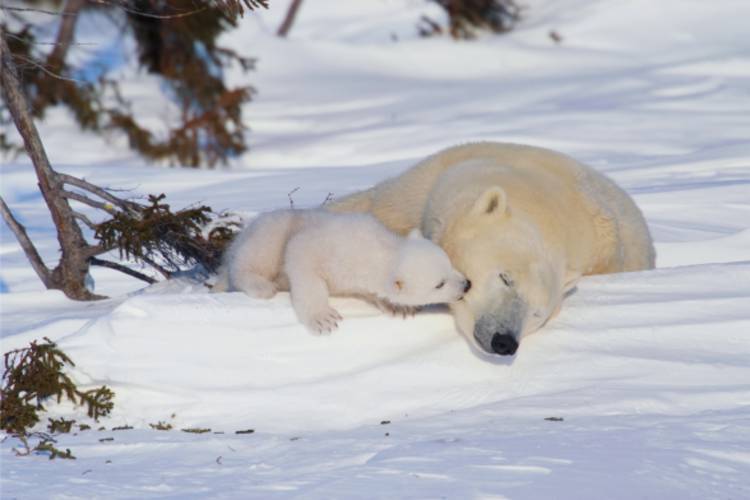
Polar bear cubs are born in snow caves called maternity dens. After feeding heavily in April or May, female bears that have mated dig a den in late October or early November. Most choose den sites in snowdrifts along mountain slopes or hills near the shore. Some dig their dens in snowdrifts on the sea ice, and others in peat along inland riverbanks. The cubs are most often born in December.
Like a big, white rat. At birth, cubs are 30 to 35 centimeters (12 to 14 inches) long and weigh little more than half a kilogram (about one pound). They are blind, toothless, and covered with short, soft fur. They are completely dependent on their mother for warmth and food.
In March or April. During her time in the den, the mother does not eat, drink, or pass waste. Cubs grow rapidly, thanks to the calories in their mother's rich milk, which is about 31% fat when the cubs are born. In their first year of life, cubs are called COYs, which stands for cubs of the year.
Only humans, and on rare occasions, other polar bears. Some scientists hypothesize that food stress is increasing acts of cannibalism, which has historically been a natural, but infrequent event.
Not at all. Ninety-seven percent of climate scientists, the experts in their field, have reached a consensus that climate change is real and is human-caused.
We don’t have evidence that such foods could provide enough nutrients to sustain any of the existing populations of polar bears. It’s true that polar bears have evolved to eat seals, but they are opportunistic hunters and if seals are not available because the sea ice is absent, they will eat almost anything—including vegetation, berries, geese, and bird eggs. Unfortunately, few polar bears have been observed eating more nutritious foods like birds or eggs, and those foods are not abundant enough or distributed widely enough to be a population benefit. And plant foods are just not nutritious enough to compensate for lost seals. Much like a human eating a stalk of celery versus a juicy steak, the nutritional benefit is not the same.
No, satellite measurements show that more energy has been coming in from the sun than is escaping back to space. The earth’s heat load, therefore, has continued to increase in step with carbon dioxide caused by burning fossil fuels.
Currently, much of that heat is being absorbed by the world’s oceans. At some point the ocean will release more of that heat into the air, and we will feel a surge of warmth.
Polar bears have never faced periods as warm as we could see in the next 50 years. There have been warmer periods in the past, but they were not only cooler than what we will experience if we don’t reduce carbon dioxide emissions, they were part of natural cycles of warming and cooling. These cycles were driven mainly by the variations in the earth’s orbit around the sun and by events like massive volcanic eruptions. The current warming is not part of a cycle, and there can be no cooling unless humans take action.
The current, human-caused warming is different from anything we have ever faced. It’s important to remember that regular carbon dioxide is used and created by normal life processes, but we have been pumping large amounts of extra carbon dioxide into the air by relying on coal, oil, and natural gas for our energy needs. To stop this rampant build-up of carbon dioxide and save the sea ice that polar bears require, we must rethink and reduce our use of fossil fuels, switching instead to renewable energy sources like wind and solar.
The earth’s temperature can only continue to increase as long as carbon dioxide emissions rise. The earth won’t heat up to some new stable level and then hold steady. Without our action, the planet can only continue to become hotter and hotter, beyond anything polar bears (or humans) have experienced before. When we burn fossil fuels for energy, we add more and more carbon dioxide into the atmosphere. This build-up acts like a blanket, trapping heat that would have otherwise escaped. The key to getting the climate back to functioning the way it should is to get away from fossil fuels for energy altogether and to look for ways to influence decisions outside our own households about where our energy comes from.
We live in this world together. If we work collaboratively and act on climate warming before it gets worse, we all win, and the polar bear will continue to roam the Arctic for generations to come.
We have never had firm numbers on the global population of polar bears. We do know that some polar bear populations, like those that I studied in Alaska for 30 years, were known to have grown after excessive hunting was controlled in the early 1970s. But we only recently have developed estimates of several populations and still have no estimates for others. Regardless of how many bears may have been around at times past, however, as long as temperatures warm and sea ice habitat continues to decline, polar bears ultimately can only decline. Wild polar bears will become extinct unless we take action to reduce greenhouse gas emissions.
Increased interbreeding will not preserve the magnificent life form that is today’s polar bear. It might preserve some polar bear genes in an animal similar to today’s grizzly bear—but that is not what we are after. Scientists have observed a few polar bear-grizzly hybrids in the wild, and genetics studies indicate some interbreeding has occurred for millennia. Regardless, given the rapid pace of current sea ice losses, polar bears will starve out of their present range long before grizzlies swamp their genes.
Definitely not! Together, we can protect polar bears and people by holding civic leaders accountable for reducing our reliance on fossil fuels for energy and strengthening renewable energy approaches.
To build support for transitioning away from fossil fuels, each and every one of us needs to be confident about talking to our friends and family about the urgent need for climate action. Find out how you can take action for polar bears.
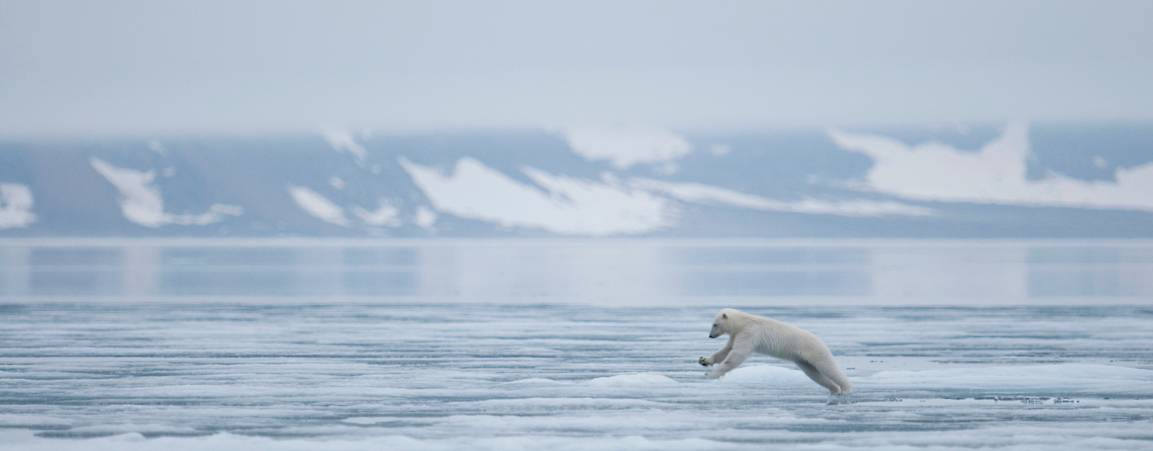
Sea ice is as important to the Arctic as soil is to the forest. When ocean water gets cold enough to freeze it expels its salt, causing channels to form in the ice. Algae grow within these channels and form the base of the food chain. Algae feed the tiny organisms, like zooplankton, that inhabit these waters. Arctic cod feed on them. Seals eat Arctic cod. And polar bears prey on seals.
Polar bears rely on sea ice to efficiently catch their main prey, ice seals. Although seals can out-swim polar bears underwater, bears have the edge on top of the ice—using it to sneak up on and stalk their next meal. Ice seals, and related ice-dependent species like the walrus, rely on sea ice for survival, too. They use it to rest on and as a platform for giving birth to and raising their pups.
Arctic sea ice is important to people living in the North, providing a platform for transportation and increased access to food. But people around the world need sea ice too. Sea ice acts like a global air conditioner, helping to cool the planet by reflecting the sun's light and heat back into space—rather than absorbing it into the water.
Some sea ice still remains in the Arctic year-round, with the lowest extent occurring each summer in September. Despite year-to-year variation, satellite data shows that the rate of sea ice decline for September sea ice is 82,300 square kilometers (32,000 square miles) per year, or 12.8 percent per decade compared to the 1981 to 2010 average. That’s like losing an area the size of South Carolina or New Brunswick every year.
Arctic sea ice is declining in both extent and thickness due to human-caused climate warming. When we burn fossil fuels like coal, oil, and gas, we release carbon emissions into our atmosphere. These emissions act like a heat-trapping blanket: too many emissions trap too much heat around our planet. Just as a warm summer's day melts the ice in a glass of water, a warming planet causes Arctic sea ice to melt.
Yes! Less sea ice = extra heat absorbed into the ocean = less heat reflected away from Earth = disrupted climates. Just as a heart circulates blood and regulates the body’s temperature, the ocean controls the world’s climate system by circulating heat, moisture, and nutrients around the planet. Disruptions in this system, such as extra heat, have global impacts and can lead to more frequent and extreme weather events around the world— impacting agriculture, infrastructure, economics, and human lives.
Despite the threats, it’s important to remember that it's not too late to save Arctic sea ice. Studies show there is no tipping point. The ice will rebound if we work together now to shift away from fossil fuels, replacing them with renewable energy sources like solar and wind. Not only will this help reduce the carbon emissions that are causing the planet to warm and the sea ice to melt, it will also create jobs, strengthen the economy, and improve the overall environment and our health.
The Polar Bear Tracker follows the movements of satellite-collared polar bears in Hudson Bay, Canada. The tracking is part of a long-term research project conducted by our partners at the University of Alberta and Environment and Climate Change Canada.
If you don’t see recent updates, don’t worry! The tracking device may be experiencing technical difficulties due to the harsh Arctic habitat and is offline for now. This is normal and the bear may come back online soon.
The GPS collars allow researchers to track polar bears, helping us learn about their movements in response to sea ice loss caused by climate change. Because polar bears prefer to roam far out on sea ice, where it is dangerous for humans to travel, data from satellite collars gives scientists a rare glimpse into the lives of polar bears, including the habitats they use and the vast distances they travel.
The GPS collar transmits location data to a satellite, from which researchers can then download movement information. The collar’s battery life depends on how often it shares data. To prolong the battery life, the collar typically sends data to the satellite every four hours.
Collars are built with flexible, synthetic material that sheds water and ice and stays flexible in cold temperatures but is strong enough to withstand Arctic marine conditions for at least one year.
Adult males can’t be collared because their necks are as wide as their heads, so the collars slip right off! And juvenile bears grow too quickly to fit with a collar.
We use the term “real-time tracking” because the collar transmits location data to the collection site several times a day. However, we receive the information weekly and deliberately delay publishing the data. We publish 1-3 new locations roughly once a week as available, usually from October to July.
It is difficult to make technology reliable in the Arctic. The Arctic’s harsh and remote environment makes tracking polar bears challenging and costly. The cold weather, freezing salty waters, and bears who like to rub on the sea ice take a toll on the collars. Sometimes collars stop transmitting for a few months or sometimes they power down entirely until they fall off.
Each collar is programmed to last 1-2 years, then automatically fall off using a timer. Some bears have been collared more than once throughout their lives (contributing extremely important data to our understanding of polar bears), but not for longer than two years at one time.
These days, most collars are programmed to last one year or less. If a collar lasts a full 12 months on a polar bear, researchers are pretty happy.
The collars have a release mechanism with an internal clock that researchers can program. Researchers usually set the timer so that the collar will fall off shortly before the batteries are drained, and the collar is no longer transmitting.
Also, the collars are attached with steel nuts and brass bolts that eventually corrode in a saltwater environment, causing the collar to fall off even if the release mechanism fails. Once they fall off, a GPS location allows researchers to find the collar (if in a retrievable spot), download any stored data, refurbish, and send it out again to save money.
The number of collared bears varies according to project goals, the region, how well-funded a project is in a given year, and how successful researchers are in catching adult females. Usually, 5-10 bears are collared in western Hudson Bay each fall.
Right now, collars can provide the longest and most robust datasets for polar bear movements on sea ice. GPS-linked ear tags have been deployed on male polar bears in recent years with some success, but they rarely last longer than 5 or 6 months. We are currently developing and testing new methods of tracking polar bears that can both withstand Arctic conditions and allow scientists to track adult males and juvenile bears, providing critical data on these two key groups. Check out our Burr on Fur project!
Yes! We encourage teachers and students to make use of the Bear Tracker when possible. Our lessons and materials, along with our Tundra Connections webcasts, make for a wonderful way to learn about polar bears in the classroom.
Unfortunately, we are not able to share the actual coordinates of the bears, as the GPS data do not belong to us. Also, the data are currently being used for research projects that have not yet been published, and so are not available to the public at this time.
For publicly available polar bear data, please check out the USGS Polar Bear Research page.
Want to Dive Deeper?
Explore more in-depth answers from our scientists in Ask the Experts.
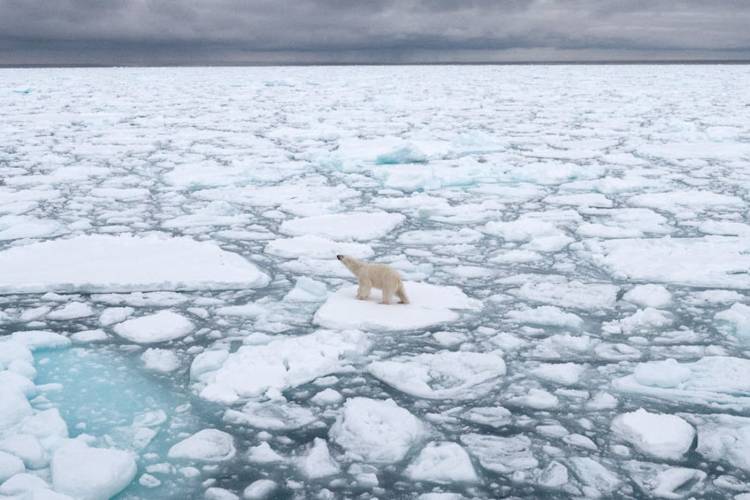
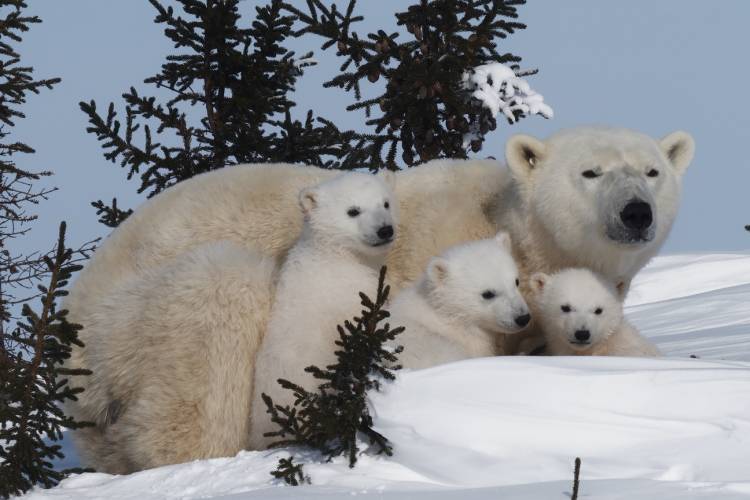
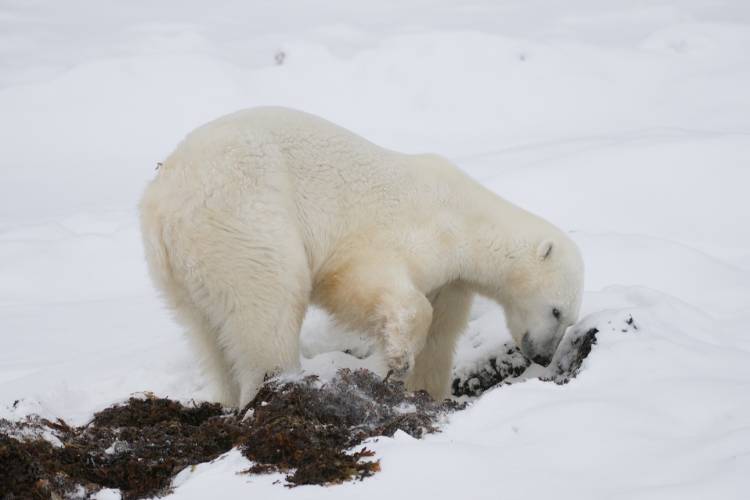

Photo: Kt Miller / Polar Bears International
Grounded in Science
Guided by leading polar bear and climate researchers, we take a science-based approach to conservation—applying research data and findings to real-world solutions.

Photo: Robert Sarren
Join Us On Our Journey
Want more polar bear information in your inbox? Become part of a community committed to protecting polar bears with our free newsletter.
Donations, Sponsorships, and Other Fundraising Questions
We are so inspired by people who support our efforts through special fundraising events. Your hard work helps motivate others to get involved in actions to preserve polar bears and their future.
If you are interested in supporting Polar Bears International through a limited fundraiser (examples include, but are not limited to, birthdays, bake sales, fun-runs, school fundraisers, art fundraisers, polar bear plunges, etc.) you are welcome to mention that Polar Bears International will be the recipient of a donation with the following disclaimer: [NAME] is not affiliated in any manner with Polar Bears International or any of its programs, projects or websites.”
You are welcome to reference our website in directing people to a source of additional information; we would recommend the following language: "For more information about polar bear conservation, please go to www.polarbearsinternational.org and find out how to get involved."
We also invite people interested in starting a fundraiser to check out the Start A Fundraiser page on our website. You can set up your own fundraising page using our peer-to-peer fundraising platform, and invite your friends and family to support your challenge. Alternatively, you can set up a fundraiser on Facebook or Instagram and name Polar Bears International as the benefactor.
We request that you contact one of our development professionals prior to launching any event so we can advise you on some ideas for conducting a successful fundraiser. You can reach our team at members@pbears.org.
You can read our full fundraiser disclaimer here.
Polar Bears International is happy to accept donations through our online donation form, but we understand that not everyone is comfortable sharing important financial information online. Therefore we want to provide alternative methods for supporting our work.
For those who would like to give a gift to polar bears offline, we have created a downloadable remit form you can fill out and send in with your mailed donation. A tax receipt for your gift will be sent out as soon as it is processed. If you have made a donation through the mail and did not receive a tax receipt within 3 weeks of mailing, please contact us at fundraising@pbears.org.
For gifts made in U.S. dollars, please send your donation to:
Polar Bears International, P.O. 3008, Bozeman, MT 59772
For gifts made in Canadian dollars, please send your donation to:
Polar Bears International - Canada, PO Box 4052, 1155 Main Street Station B, Winnipeg, MB R2W 5K8
For international donations, alternatively, we accept wire transfers. To learn more about wire transfers, email fundraising@pbears.org. Please note, only donations made by eligible U.S. and Canadian taxpayers may be tax-deductible.
For more information about how your donation impacts polar bear conservation, you can visit our website to review our financial documents, including annual reports and audited financial reports. Also visit our impact page to see how your support makes a difference.
Polar Bears International maintains the highest rating from Charity Navigator and Guidestar and we’re dedicated to ensuring fiscal responsibility and transparency.We carefully shepherd all donations to support our conservation efforts.
At Polar Bears International, 80% of all the money raised goes directly toward our program work, which includes scientific research, coexistence efforts, education, and advocacy. To learn more about our various conservation and research projects as well as our extensive outreach and education projects please visit our website.
You can also visit our Latest Stories page to find articles that highlight some of our accomplishments.
Polar Bears International is a registered charity in the United States (Charitable ID 77-0322706), and Canada (Charitable Registration No. 862722279 RR0001). If you are a U.S. or Canadian donor, we can provide a tax receipt for your contribution to polar bears.
It is very important to our team that you receive an acknowledgement from us as soon as your gift is processed. If you donated to Polar Bears International through our online portal, a donation receipt will be automatically delivered to your email address immediately after your contribution is received. However, receipts can occasionally be marked as spam. If you didn’t receive your tax receipt, we suggest checking your spam or junk mail folders to make sure this hasn’t happened. If you have checked your spam folder and still haven’t received your receipt, please contact us at fundraising@pbears.org and we will issue a new receipt.
If you have donated through the mail, please allow two weeks from the time of your gift to receive your tax receipt. If you mailed a gift to one of our offices and haven't received your receipt in a timely manner, please contact us at fundraising@pbears.org. We can confirm if your gift was received, and issue a new receipt for your records.
Polar Bears International now accepts cryptocurrency donations through The Giving Block in the U.S. and Canada. The Giving Block purchases 2x carbon offsets everytime you donate crypto. To learn more about how to donate cryptocurrency, please visit our webpage:
Donate Cryptocurrency and Stock - U.S.A
Donate Cryptocurrency - Canada
At Polar Bears International, we appreciate all businesses that are interested in supporting conservation. By partnering with the business sector, we can reach new audiences to help build awareness about polar bears and the challenges they face. Polar Bears International seeks partnerships with businesses that apply principles of environmental welfare to the production of their own products, processes, and services, and by association, polar bears.
We are looking for leaders and key influencers of corporate responsibility in their respective markets that can allow us to further our mission to conserve polar bears and a healthy climate future for us all. To be considered for a corporate sponsorship, you can apply by sending in a short application that provides us with information about your business and your interest in joining our mission.
Sponsorship levels begin at $35,000 and we restrict the use of the Polar Bears International logo for higher-level sponsorships. We also offer a Friends of the Bear corporate donor level for companies interested in donating between $15,000-$35,000. For more information, please contact members@pbears.org
You can also review the Fundraiser Disclaimer to learn more guidelines to raise funds to support polar bear conservation.
Thank you for being a special member of our Polar Bear Patron Community. As a monthly donor, you are part of a valued group of supporters who make our work possible 365 days a year. Your ongoing commitment ensures that we keep the needs of polar bears and the people who live with them, front and center all year long.
We want to make it easy for you to manage your monthly gift with us. If you need to make any changes to the timing and/or amount of your contribution or change your credit card information, please contact us at fundraising@pbears.org. You can also contact us by phone, 406-586-9416, Monday-Friday, between 9:00 a.m. to 5 p.m. MT. Our fundraising team will be happy to help update your information.
Thank you for your continued support and for being a Polar Bear Patron!
Bear Tracker
Polar Bears International’s Bear Tracker program is an ongoing research project conducted by the University of Alberta and Environment and Climate Change Canada. This project is designed to learn more about polar bear movements in Hudson Bay related to changes in the sea ice. Data is collected from female polar bears fitted with GPS collars. They transmit location information to satellites, which is then downloaded by scientists to study. The data can tell researchers where bears travel throughout the year, how far they go, if they spend time near human settlements, and how long they are off the sea ice. This data can also be viewed over time to uncover important patterns, such as when bears leave the ice and where they spend most of their time.
The process involved in collaring and tracking bears is extremely difficult, dangerous and expensive. Therefore, participation in the Bear Tracker program is limited to our aquariums and zoo partners, as well as corporate sponsors who use this information to bring awareness to their vast audiences.
The Bear Tracker program is significantly different from our symbolic adoption program. Through our symbolic adoption program, supporters can purchase kits or eco-adoptions that help support our conservation mission. Adoptions are not linked with the live bears listed on our bear tracker map.
Wildlife Tracking Bracelets through Fahlo
In 2020, Polar Bears International welcomed a corporate sponsor, Fahlo (formerly known as Wildlife Collection). Fahlo offers customers the opportunity to purchase bracelets which follow the movements of select wildlife species on a tracking app. Ten percent of sales from their Save the Bear campaign supports the conservation efforts of Polar Bears International.
While Fahlo offers the opportunity to track polar bears through their app, their program is independent from Polar Bears International’s Bear Tracker. Polar Bears International is not involved in the delivery of wildlife tracking bracelets and does not maintain the tracking pages for our partners at Fahlo.
Support Our Work